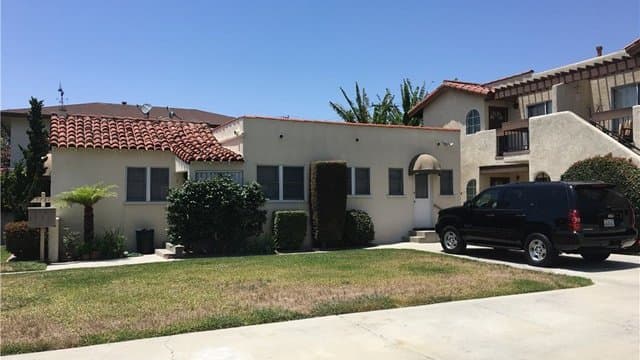
House hacking means living in one unit of a multi-unit property and renting out the others. The rent from your tenants helps cover the mortgage, taxes, and insurance. At 7781 15th St in Westminster, the layout is well suited to it: you can live in the detached 1928 front house and rent the three rear triplex units.
Before getting into the numbers, a word on expectations. At a $2,325,000 price, this is a large purchase. We think buyers are best served by realistic math, so this article shows an illustration rather than a promise.
The rental income available
The three rear units currently produce $7,045 per month combined, and the pro forma assumes $9,200 per month combined. As an owner-occupant, you would not collect rent on the front house, since you would live there.
An illustrative payment
Assume, for illustration only, a 5 percent down payment, a 30-year fixed loan, and a 6.5 percent interest rate. These are placeholders, not a quote, and your rate will depend on your lender and your profile.
- Loan amount: about $2,208,750
- Principal and interest: roughly $13,960 per month
- Property taxes: commonly around 1.1 to 1.2 percent of price annually in Orange County, which is roughly $2,200 per month
- Insurance and mortgage insurance: additional, depending on your quote
That puts the total monthly housing cost in the neighborhood of $16,500 or more under these assumptions.
What the rents would cover
Against that figure, current rear-unit rents of $7,045 would offset roughly 40 to 45 percent of the payment. At the pro forma rent of $9,200, the offset would be roughly 55 percent. Your own cost would be the remainder, plus maintenance and any vacancy.
That is a meaningful reduction, but it is not a free home. A larger down payment, a lower rate, or higher rents would improve the picture, and a smaller down payment or higher rate would worsen it. We would rather you see that clearly now than discover it at closing.
Why buyers still consider it
- Housing cost offset. Tenants pay down a substantial share of your monthly cost.
- Principal paydown. Part of every payment builds your equity.
- Single-family feel. The front house is detached.
- Growth potential. Rents that move toward the pro forma improve the offset over time.
- Tax considerations. Rental property can carry depreciation and expense deductions. Discuss this with a CPA.
Questions to ask yourself
- Can I comfortably carry the net payment if one unit is vacant for a few months?
- Do I have reserves for repairs on a 1928 house and a 1987 triplex?
- Am I ready to be a landlord, or will I hire a property manager?
Common questions
Do I have to live there? For owner-occupant loans, you generally must occupy one unit as your primary residence for a required period. Confirm the exact terms with your lender.
What if a unit sits empty? Your net cost rises for those months. Keep reserves that can cover several months of vacancy and repairs.
Is this a good fit for everyone? No. It suits buyers with substantial capital, stable income, and comfort with landlord responsibilities. Run your own scenarios and speak with a licensed lender and a CPA.
Key takeaways
- House hacking here can offset a meaningful share of housing cost, but at this price it does not eliminate it.
- Your result depends on down payment, rate, taxes, insurance, vacancy, and repairs.
- Run your own scenario with a lender before you decide, and keep reserves for the months when a unit is empty.
Next step
Build your own scenario. Use the savings calculator with your actual down payment, rate, and reserves to see what your net monthly cost would be.
Listed by Century Financial Group Corp. (Karen Luu). Figures reflect seller-provided information and are not guaranteed. Buyers should verify all details during due diligence. This article is general information, not tax, legal, or financial advice.